Colour models (RGB & CMYK)
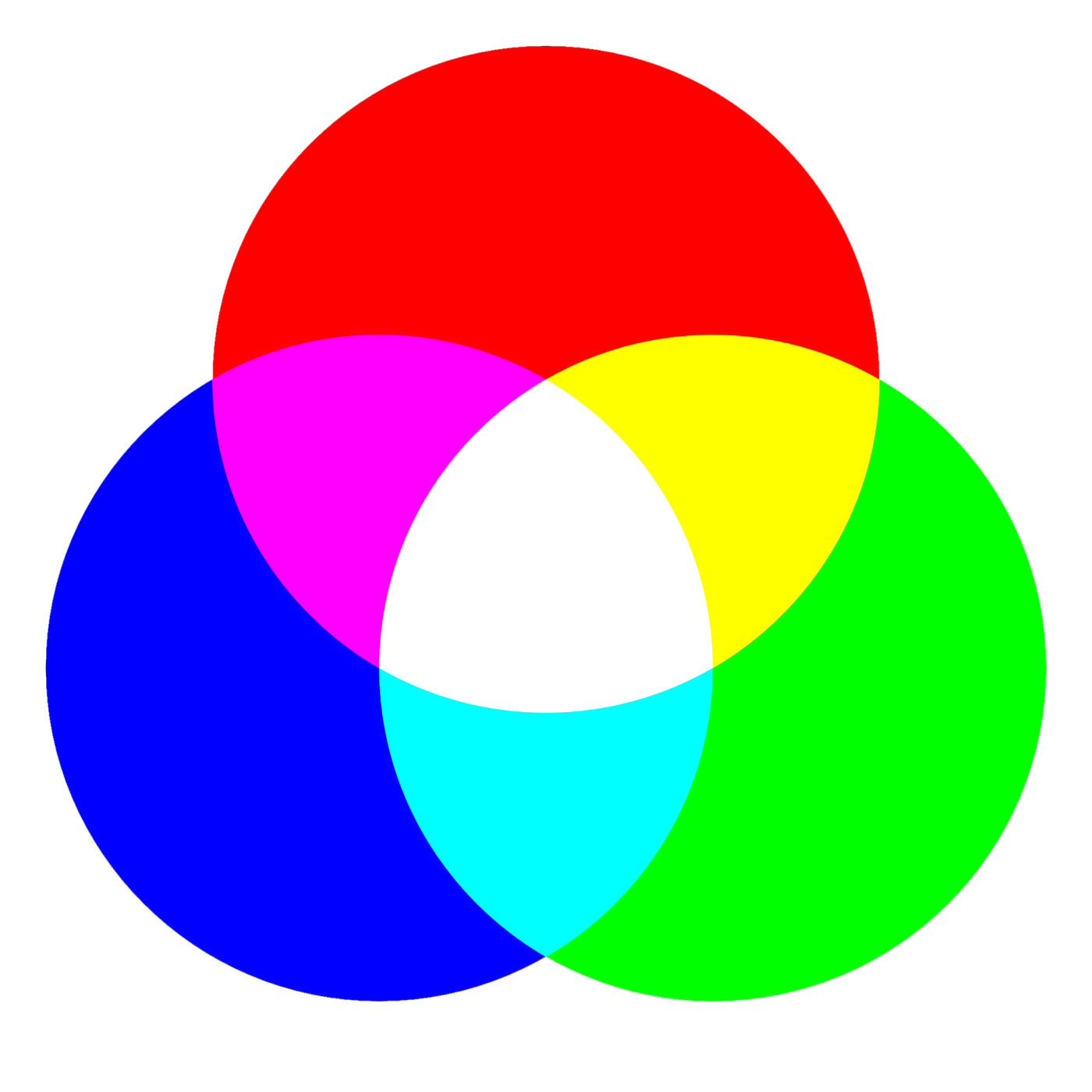
All colours are defined by different colour models.
Some of them are, for example:
RAL
RAL-Farben sind normierte Farben. Sie werden vor allem im Bezug auf Anstriche und Lacke verwendet.
Pantone
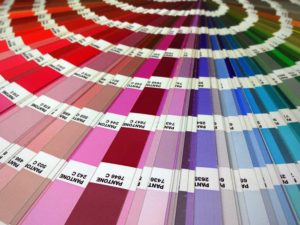
Satz von 18 Basis-Farben. Das ganze PMS (Pantone Matching System) umfasst dabei 1755 Farben. Ein 4-Farben-Drucker kann diese Farben niemals exakt und vollständig abdecken.
For printing, however, only RGB and CMYK are relevant for us, so we will focus more on these two colour models in this article.
RGB
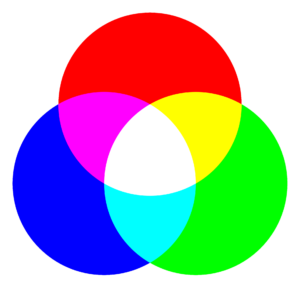
Initialien (English)
R – Red (Rot)
G – Green (Grün)
B – Blue (Blau)
Bereich
Das RGB-Modell basiert auf der Darstellung von Farben auf einem Bildschirm, wie auf dem Computer oder auf dem Fernseher.
Colour mixing
Additive
If all the colours are mixed together, you get the colour white. That is why it is additive.
Why is the end result white?
Imagine the rainbow. It comes from the separation or diffusion of the white colour, that is, by adding these colours you get the white. Since the RGB model refers more to the representation on screens (light), its combination logically leads to white. You can find more information on the development of colours in our article "What are colours? How are they created?".
You've probably asked yourself: "So how do we get the colour black?"
You may have heard this expression from physics before: darkness does not exist, but a lack of light does.
The same happens on the screen. To keep the black colour, simply switch off the colours/lights.
Colour variants
By combining just three colours, you can obtain millions of variations. And that's no exaggeration. You can get exactly 16.7 million colours. Where does this number come from?
Primary colours (red, green and blue) can be mixed in very different ways.
Each end colour has a percentage of the base colour in the final result. For example, a little blue, a lot of red, just a little green, everything reversed, etc. The amount of each colour varies between 0 and 255, i.e. there are 256 variations of each of the three primary colours. If we do the quick maths, we get: 256 x 256 x 256 = 16.7 million.
This resolution is called TRUE COLOR labelled.
Although it appears that these combinations have many colours, the number is limited compared to the natural colours. However, as the human eye can no longer recognise the levels of the colour gradient, photo-realistic representations are possible.
We have looked at one of the two colour models. Let's now focus on the CMYK model.
CMYK
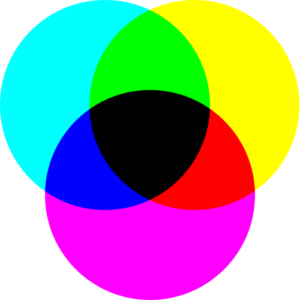
Initialen (Englisch)
C – Cyan
M – Magenta
Y – Yellow (Gelb)
K – Key (steht für Schwarz)
Bereich
Das CMYK-Modell ist typisch für den Druck. Die meisten Druckereien drucken ihre Daten mit diesem Modell. Da der Monitor die Farben mit dem RGB darstellt, müssen die Farben ins CMYK-Modell konvertiert werden, damit sie gedruckt werden können. Dazu benötigen Sie ein Konvertierungsprogramm: ICC-Profil (siehe Artikel «Colormanagement bei printolino»).
Colour mixing
Subtractive
This means that the colours must be subtracted to obtain the white, i.e. nothing should be printed. The white is simply the non-existence of the colour.
This principle is exactly the opposite of RGB. To obtain the white colour, it is necessary to add the colours red, green and blue to obtain the white light, that is, if it is an additive colour mixture.
How do you get the colour black?
You could come up with this reasoning: If in the RGB model the white is obtained by combining colours and the black is obtained by shooting and if in the CMYK the opposite is the case (white is obtained by removing the colours), then the black colour is the mixture of all colours. This is the difference between these two colour models.
However, if you have already tried to mix all the colours, you will have noticed that the result is not a perfect black. It is therefore necessary to add a fourth element: Key (black). For this reason, the CMYK model has 4 initials and the RGB only 3.
The result on a printed sheet is never exactly the same as in real life, as not all colours are present, but a crossover of colours.
However, you can get so close to the actual colours that it is (almost) indistinguishable to the human eye.
Did you know?
You may have wondered why the black colour of the CMYK model is represented by a K (Key). Wouldn't it be more logical to be B (Black)? It used to be. However, since the letter B for blue already existed, especially for the RGB model, the letter was changed to K to avoid confusion.
The 5th colour
When printing, there is a fifth colour to consider: the colour of the paper.
If the paper is yellow, e.g. newsprint, the colours must be set to a lighter profile and vice versa.
The paper colour, surface texture, paper thickness and opacity (light transmission) are important.
Sequence
The order of the colours can result in the colours looking different to our eyes.
For example, if you put red first and then yellow, the result will be different than if it were the other way round. This is because the colour at the top is the most dominant.
Lighting
The lighting also has an effect on the colours. It is therefore always a good idea to use lamps with standard light when analysing the colours.
Conclusion
Printolino takes colour conversion very seriously. Before printing your images, the colours are controlled in detail. Colour analysis tests are carried out regularly as secondary factors such as paper colour, ink manufacturer and even the printers themselves can vary to the point where you may notice a difference. With us, you can be sure that the colour conversion is very accurate and that the desired result is a realistic colour print.
We hope that we have been able to help you with this article about the colour models. For a more detailed explanation, watch the following video.